
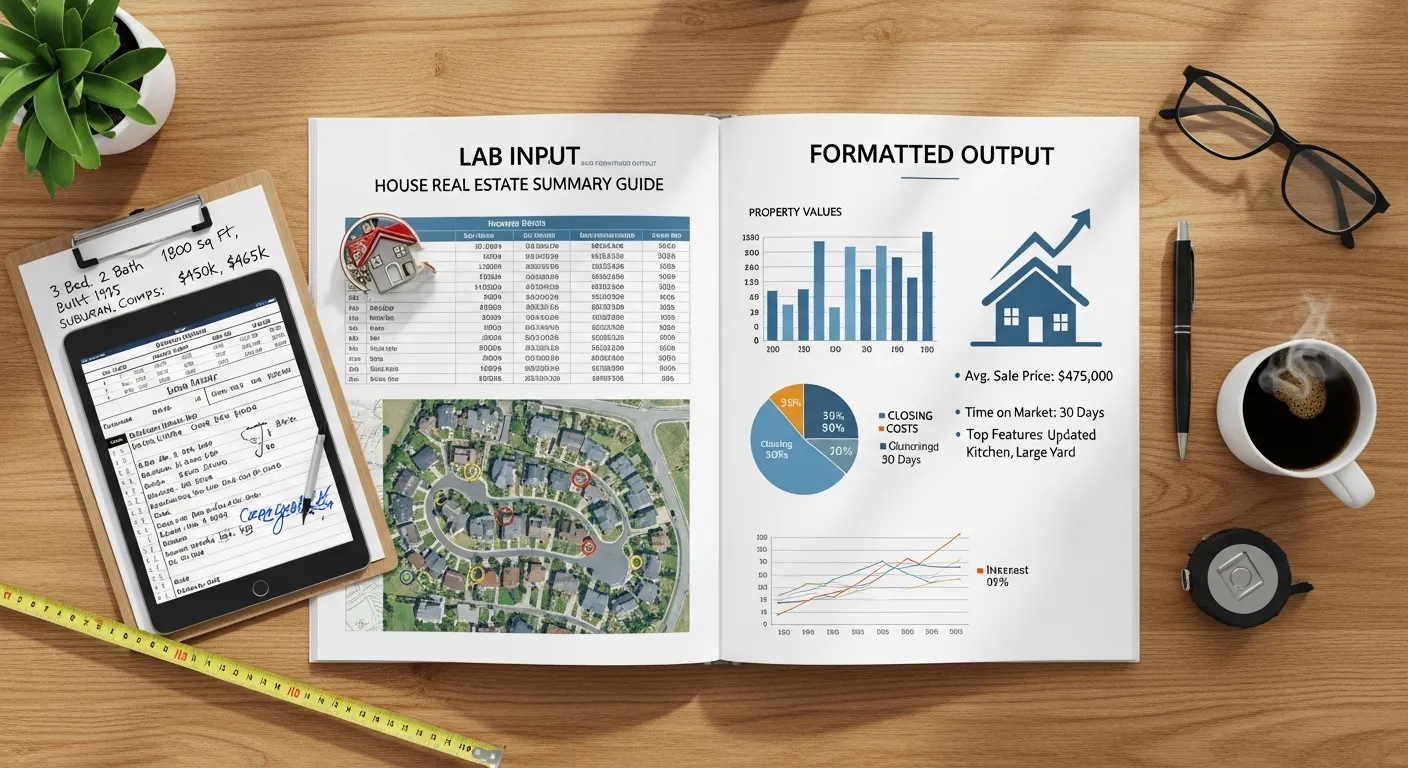
This comprehensive guide breaks down the mechanics of processing real estate data from raw inputs to polished outputs. We will explore the core mathematical logic used to calculate price changes and estimated mortgages. You will discover practical applications, common pitfalls in data formatting, and expert strategies for building robust property summary tools.
Structuring raw property data into readable, actionable information forms the backbone of modern property technology. Whether you are a computer science student tackling a university assignment or a data analyst building a property valuation tool, understanding the lab input and formatted output house real estate summary process is incredibly valuable. This concept teaches the fundamental logic behind how platforms like Zillow and Redfin ingest basic numbers and generate comprehensive, user-friendly property dashboards.
Understanding the Lab Input and Formatted Output House Real Estate Summary

At its core, the lab input and formatted output house real estate summary is a foundational exercise in data processing. It requires a program to accept specific variables, perform basic arithmetic, and return a clean, structured string of text. In the context of real estate, these variables usually represent property values over time.
The standard scenario involves taking two integer inputs: the current price of a house and its price from the previous month. The program must then calculate the difference between these two values to determine market movement. Finally, it calculates the estimated monthly mortgage, typically using a simplified formula based on a fixed interest rate and loan term.
Mastering this data flow is essential for anyone interested in real estate software development. It bridges the gap between backend calculations and frontend user experience. When users look at a property listing, they do not want to see raw database entries. They want a clear, formatted summary that tells them exactly what the property costs and how much they need to pay each month.
The Role of Raw Data Inputs
Every successful real estate analysis tool starts with accurate inputs. In a basic programming lab environment, these inputs are typically provided via standard input streams. The user types in the current house price followed by the prior month’s price. The program stores these values in designated memory variables.
In real-world applications, these inputs come from massive databases, Multiple Listing Services (MLS), or automated web scrapers. Ensuring the integrity of this input data is crucial. If the raw integers contain formatting errors, such as unexpected commas or currency symbols, the subsequent calculations will fail. Proper input validation prevents these errors from crashing the system.
Formulating the Formatted Output
The output phase is where the magic happens. The program takes the calculated data and presents it using specific formatting rules. This usually involves printing the current price, the calculated change since last month, and the estimated monthly mortgage.
String formatting functions are used to ensure the output looks professional. For example, a developer might use f-strings in Python or printf in C++ to align the text perfectly. This formatted text provides the exact structure needed to populate a clean real estate summary dashboard, making the financial data easy for potential homebuyers to digest.
Core Calculations in Real Estate Summaries

To generate a meaningful real estate summary, you must apply specific financial calculations to your raw inputs. These formulas transform static numbers into dynamic market insights.
Calculating Market Fluctuation
The first calculation determines the property’s price change over a specific period. You simply subtract the previous month’s price from the current price. A positive result indicates market appreciation, while a negative result shows depreciation.
This simple metric holds immense value for property investors. It helps them gauge neighborhood trends and assess whether a property is gaining or losing value. When building automated property valuation models, this calculation serves as the baseline for predicting future market movements.
Estimating the Monthly Mortgage
The second critical calculation involves estimating the monthly mortgage payment. In basic academic labs, this is often calculated using a hardcoded formula, such as multiplying the current price by a set interest factor (like 0.051) and dividing by 12 months.
Real-world applications use much more complex amortization formulas. They factor in down payments, variable interest rates, property taxes, and homeowners insurance. However, the foundational logic remains identical: take an input variable, apply a mathematical formula, and format the resulting float into a clean currency string.
Translating Academic Labs to PropTech Solutions

The skills learned in a basic input and output lab translate directly to enterprise-level property technology. Companies invest millions of dollars into ensuring their data pipelines run efficiently and their user interfaces look pristine.
Developing User-Centric Dashboards
When a user clicks on a property listing, they expect instant access to financial summaries. Backend engineers use the same input/output principles to pull data from servers and push it to the frontend. The data must be formatted consistently, regardless of whether the property costs fifty thousand dollars or five million dollars.
This requires rigorous attention to edge cases. What happens if the previous month’s price is missing from the database? A well-designed program will handle this exception gracefully, outputting a default message rather than throwing an error. Designing resilient code ensures a smooth experience for the end user.
Integrating with External APIs
Modern real estate platforms rarely rely on manual data entry. Instead, they use Application Programming Interfaces (APIs) to pull current market data automatically. Developers write scripts that input API data, parse the JSON or XML responses, and format the output into localized summaries.
Familiarity with these data structures is why utilizing robust real estate data analysis tools has become standard industry practice. These tools handle the heavy lifting of data ingestion, allowing developers to focus entirely on refining the formatting and output presentation.
Structured Comparison of Data Processing Methods
Different programming languages and tools handle real estate data formatting in unique ways. Understanding these differences helps you choose the right approach for your project.
|
Processing Method |
Input Handling |
Output Formatting |
Best Use Case |
|---|---|---|---|
|
Python (f-strings) |
Fast, dynamic typing |
Highly readable, easy variable insertion |
Rapid prototyping, data science, academic labs |
|
C++ (cout/printf) |
Strict typing, requires explicit declaration |
Precise control over memory and decimal places |
High-performance backend financial systems |
|
JavaScript (Template Literals) |
Asynchronous inputs via DOM |
Ideal for web-based UI rendering |
Frontend real estate dashboards and calculators |
|
Excel/Spreadsheets |
Manual entry or CSV import |
Built-in currency formatting rules |
Solo investors analyzing individual deals manually |
Common Mistakes to Avoid
When building programs to handle real estate inputs and outputs, developers frequently encounter similar stumbling blocks. Avoiding these errors will save you hours of debugging.
- Ignoring Data Types: Treating a string input as an integer will crash your calculation functions. Always cast your inputs to the correct data type (integer or float) before performing math.
- Hardcoding Currency Symbols Incorrectly: Placing a dollar sign in the wrong spot or failing to account for international currencies ruins the output format. Use built-in localization libraries to handle currency formatting automatically.
- Neglecting Decimal Precision: Mortgage calculations often result in long floating-point numbers. Failing to round these numbers to two decimal places makes the output look messy and unprofessional.
- Overlooking Negative Values: If a house depreciates, the price difference becomes negative. Ensure your formatted string handles negative numbers gracefully, perhaps by adding a minus sign or formatting the text in red.
- Skipping Input Validation: Users make mistakes. If someone inputs letters instead of numbers for a house price, the program must catch the error and prompt them to try again rather than shutting down completely.
Pro Tips for Advanced Real Estate Data Formatting
Take your data processing skills to the next level by implementing these expert-approved strategies.
- Use Descriptive Variable Names: Instead of using
xandy, usecurrent_priceandlast_months_price. This makes your code infinitely easier to read, maintain, and debug. - Modularize Your Code: Separate your input logic, calculation logic, and output formatting into distinct functions. This makes your program easier to scale if you need to add new features later, like tax calculations.
- Implement Unit Testing: Write automated tests that feed specific inputs into your program and verify that the formatted output perfectly matches your expectations. This ensures your math remains accurate as you update the code.
- Account for Commas in Large Numbers: Real estate prices are large. Use formatting flags to automatically insert commas into your output strings (e.g., formatting 1000000 as 1,000,000). This drastically improves human readability.
The Importance of Clean Data in Real Estate
Clean, well-formatted data builds trust. When a potential buyer or investor reviews a property summary, they need to trust the numbers. If the formatting is misaligned or the math appears incorrect, they will immediately abandon the platform.
This principle applies equally to automated marketing efforts. Real estate agencies often send automated text messages or emails containing property summaries to prospective clients. If the data extraction and formatting process is flawed, the resulting message will look like spam. Ensuring pristine data outputs protects your brand reputation and keeps your audience engaged.
By mastering the lab input and formatted output house real estate summary, you lay the groundwork for building reliable, trustworthy systems. You learn how to respect the data, handle it securely, and present it in a way that provides immediate, tangible value to the consumer.
Scaling Up: Batch Processing Property Data
Once you master processing a single property summary, the next step is scaling the operation. Enterprise systems do not process one house at a time; they process thousands of properties simultaneously. This requires an understanding of batch processing and data arrays.
You can modify your basic program to accept a list of current and previous prices. By looping through this list, your code can generate a formatted summary for an entire neighborhood or city in milliseconds. This is how major real estate portals update their market estimates overnight.
Handling batch inputs requires efficient memory management and optimized calculation algorithms. As you transition from academic exercises to professional software engineering, optimizing these data loops becomes a primary focus.
Enhancing the User Experience with Visual Outputs
While a text-based formatted summary is essential, modern users also expect visual representations of data. The numbers calculated in your backend program often feed directly into charting libraries.
The price difference you calculated can be plotted on a line graph to show historical trends. The estimated mortgage can be broken down into a pie chart showing principal, interest, and taxes. While the initial lab focuses on console output, the logic directly enables these advanced graphical interfaces.
Understanding how to structure your output data (often as JSON objects) allows frontend developers to easily map your calculations to visual elements. This seamless handoff between backend data processing and frontend visualization is the hallmark of premium real estate technology.
Conclusion
Mastering the lab input and formatted output house real estate summary provides a crucial foundation for data processing and software development. By understanding how to ingest raw integers, execute precise financial calculations, and format the results into readable strings, you bridge the gap between complex backend data and accessible user interfaces. Implement these coding strategies, avoid common formatting mistakes, and apply this logic to build powerful, scalable real estate analytics tools today.
FAQs
1. What exactly is a lab input and formatted output house real estate summary?
It is a programming exercise or automated process where a system takes raw data inputs, such as current and past property prices, performs calculations, and outputs a neatly formatted text summary detailing price changes and mortgage estimates.
2. Why is formatting the output so important in real estate?
Real estate deals involve large numbers and complex financial metrics. Proper formatting, such as adding commas, dollar signs, and rounding to two decimal places, ensures the data is easily readable and trustworthy for homebuyers and investors.
3. What are the typical inputs required for this process?
The most common required inputs are two integer values: the current market price of the house and the price of the house from the previous month or year.
4. How do you calculate the estimated monthly mortgage in these programs?
In basic lab environments, the mortgage is often calculated using a simplified formula, such as multiplying the current price by an interest constant (e.g., 0.051) and dividing by 12 to get the monthly cost.
5. Which programming languages are best for formatting real estate data?
Python is excellent due to its readable f-strings and robust data science libraries. C++ is highly efficient for fast backend processing, while JavaScript is ideal for rendering formatted data dynamically on web pages.
6. How do I handle negative price changes in my output?
Your code should calculate the difference normally. If the result is negative, modern formatting tools can automatically display it with a minus sign or format it in a specific way (like parentheses or red text) to clearly indicate a decrease in value.
7. Why does my program crash when I input a house price with commas?
Most basic input functions expect raw integers. If a user types “250,000” instead of “250000”, the comma causes a type conversion error. You must write input validation code to strip out commas and symbols before parsing the number.
8. How do real estate websites automate this process?
Large platforms use APIs to automatically pull daily pricing data from public records and MLS databases. This data is fed into automated scripts that execute the input/output logic and update the website’s dashboards instantly.
9. Can I use this logic for commercial real estate properties?
Yes. The foundational logic of ingesting data, calculating differences, and formatting outputs applies to any asset class. Commercial real estate simply requires additional input variables, such as capitalization rates and net operating income.
10. What is the best way to format large numbers for readability?
Always use your programming language’s built-in formatting specifiers to inject thousand separators. For example, formatting the integer 1500000 to output exactly as $1,500,000.00 makes the summary instantly comprehensible.