
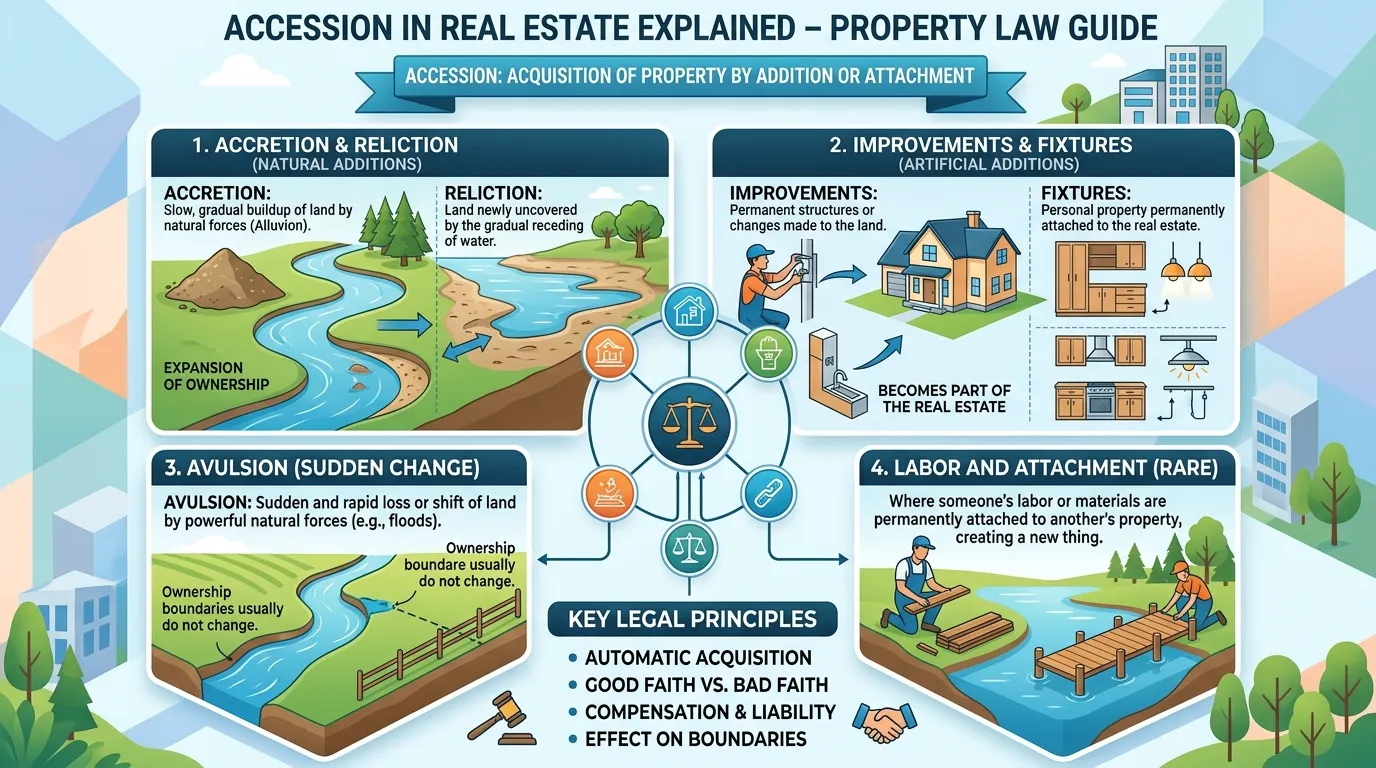
This guide explains accession real estate in depth, including legal definitions, types, ownership rules, case examples, and real estate applications. You will learn how property value changes through natural and artificial accession, how courts interpret disputes, and how investors and landowners can protect their rights effectively.
Accession real estate is a key legal principle that determines how property ownership changes when land or assets are improved or naturally expanded over time.
Understanding Accession Real Estate
Accession real estate is a legal doctrine in property law that defines how ownership of property is affected when something is added to or naturally becomes part of an existing asset.
In simple terms, accession real estate means:
When something is added to land or property, the original owner typically gains ownership of the added value or improvement.
This concept plays a major role in:
- Real estate ownership disputes
- Property improvements
- Land expansion cases
- Construction law
- Natural resource changes
According to property law principles outlined by Cornell Law School Legal Information Institute, accession is a foundational doctrine in determining property rights when additions or improvements occur.
Why Accession Real Estate Matters in Property Law
Accession real estate is important because property is not static. Land and structures evolve over time due to natural forces, human intervention, and economic development.
It answers key legal questions such as:
- Who owns improvements made on land?
- What happens when land increases naturally?
- Who gets ownership of added materials?
- How is property value reassigned legally?
Without accession real estate principles, ownership disputes would become extremely complex.
Core Principle of Accession Real Estate
- Buildings
- Trees
- Minerals
- Soil additions
- Improvements
However, legal interpretation depends on whether the addition is natural, artificial, or unauthorized.
Types of Accession Real Estate
1. Natural Accession
Natural accession occurs when land changes due to natural forces.
Examples:
- River deposits soil on land (alluvion)
- New land forms through sediment buildup
- Trees grow naturally on property
In these cases, ownership typically belongs to the landowner.
Example
If a river deposits soil and expands farmland, the landowner automatically gains ownership of the expanded area under accession real estate law.
2. Artificial Accession
Artificial accession happens when humans add value or materials to property.
Examples:
- Building construction
- Landscaping
- Installing fixtures
- Renovations
In most cases, the property owner gains ownership of improvements, even if someone else performed the work.
3. Mixed Accession
Mixed accession involves both natural and human-made changes.
Example:
- A developer builds a seawall that changes coastline shape over time
- Agricultural land improved with irrigation systems that also changes soil structure
These cases are often legally complex.
Legal Framework of Accession Real Estate
Accession real estate is governed by property law principles that vary by jurisdiction but share common rules.
Key legal foundations include:
- Ownership follows the principal property
- Improvements usually belong to landowner
- Good faith vs bad faith improvements matter
- Compensation rules may apply
For broader property law principles, the American Bar Association Property Law Resources provides authoritative legal insights.
Accession Real Estate and Ownership Rights
Ownership rights depend on several factors:
1. Good Faith Improvements
If someone improves property believing they own it:
- They may receive compensation
- Courts may consider fairness
2. Bad Faith Improvements
If someone knowingly builds on land they do not own:
- They may lose rights
- They may not receive compensation
3. Permanent Attachment Rule
If an item is permanently attached:
- It becomes part of the real estate
- Ownership transfers to landowner
Accession Real Estate in Construction Law
Construction is one of the most common areas where accession real estate applies.
Key rules:
- Buildings become part of land
- Contractors do not own completed structures
- Materials used become property of landowner
Example
If a contractor builds a house on your land, the house legally belongs to you once completed, even if the contractor supplied materials.
Accession Real Estate and Property Improvements
Property improvements significantly increase value.
Examples include:
- Home extensions
- Swimming pools
- Garages
- Renovations
These improvements are governed by accession real estate rules.
Mini Insight
Even if a tenant installs improvements, ownership usually transfers to the property owner unless otherwise agreed in contract.
Natural Accession in Real Estate Growth
Natural accession can increase land value over time.
Examples:
- Coastal expansion
- River sediment deposits
- Soil accumulation
These changes can significantly affect:
- Property boundaries
- Market value
- Tax assessments
Accession Real Estate vs Adverse Possession
Many people confuse these two legal doctrines.
| Feature | Accession Real Estate | Adverse Possession |
|---|---|---|
| Basis | Additions to property | Unauthorized occupation |
| Ownership | Original owner gains additions | Occupant may gain ownership |
| Intent | Not required | Required (continuous use) |
| Legal Outcome | Expansion of existing ownership | Transfer of ownership |
Accession strengthens existing ownership, while adverse possession can transfer ownership entirely.
Accession Real Estate in Modern Property Markets
In modern real estate, accession plays a crucial role in:
- Property valuation
- Development projects
- Investment decisions
- Land disputes
Real estate investors often analyze accession potential when evaluating long-term value.
Common Legal Disputes in Accession Real Estate
1. Unauthorized Construction
Building on someone else’s land creates disputes over ownership and compensation.
2. Boundary Changes
Natural shifts in rivers or land can change property lines.
3. Improvement Ownership
Tenants or contractors claiming ownership of improvements.
Comparison Table: Types of Accession
| Type | Cause | Ownership Outcome | Example |
|---|---|---|---|
| Natural | Nature | Landowner owns addition | River deposits soil |
| Artificial | Human action | Landowner owns improvement | House construction |
| Mixed | Both | Case-dependent | Coastal development |
Expert Insights on Accession Real Estate
Legal experts highlight three important principles:
1. Land Dominates Everything
The land is considered the primary asset.
2. Permanence Matters
Temporary items do not qualify as accession.
3. Equity Plays a Role
Courts may adjust outcomes based on fairness.
These principles ensure balance between property rights and fairness.
Real-World Example Case Study
A homeowner builds a garage extension on their property using a contractor.
Outcome:
- The garage becomes part of the real estate
- The homeowner owns it automatically
- Contractor is paid but gains no ownership
This demonstrates how accession real estate protects landowners.
Common Mistakes to Avoid
1. Assuming You Own Improvements You Built
Even if you built it, land ownership determines final rights.
2. Ignoring Contracts
Written agreements can override assumptions.
3. Confusing Fixtures and Movable Property
Not all additions qualify as accession.
4. Ignoring Boundary Surveys
Natural accession can change land boundaries over time.
Practical Applications for Investors
Real estate investors use accession principles to:
- Evaluate land expansion potential
- Assess development rights
- Understand legal risks
- Predict long-term appreciation
Accession real estate is especially important in waterfront and agricultural properties.
How Courts Decide Accession Cases
Courts consider:
- Ownership of land
- Type of addition
- Intent of parties
- Value added
- Good faith or bad faith actions
Judges aim for fairness while respecting legal ownership principles.
Future of Accession Real Estate Law
With climate change and urban expansion, accession cases are increasing.
Future trends include:
- Coastal boundary disputes
- Floodplain land changes
- Smart property tracking systems
- Digital land registry updates
Technology will improve how accession disputes are resolved.
Pro Tips for Property Owners
- Always document property improvements
- Use written contracts for construction
- Conduct regular boundary surveys
- Understand local property laws
- Consult legal experts before major development
These steps help protect ownership rights under accession real estate rules.
Accession real estate is a fundamental property law principle that determines ownership of improvements and natural additions to land. Understanding accession real estate helps property owners, investors, and developers protect rights, avoid disputes, and make informed decisions. By applying accession real estate principles correctly, you ensure long-term security and value growth. Explore legal guidance today to safeguard your property investments.
FAQs
1. What is accession real estate?
Accession real estate is a legal doctrine where additions or improvements to property become part of the original ownership.
2. Who owns improvements under accession real estate?
Generally, the landowner owns any permanent improvements made to the property.
3. What is natural accession?
Natural accession occurs when land increases due to natural forces like sediment deposits.
4. What is artificial accession?
Artificial accession refers to human-made improvements like buildings or landscaping.
5. Can a builder claim ownership of a house they built?
No, unless a legal agreement states otherwise.
6. How does accession differ from adverse possession?
Accession strengthens ownership, while adverse possession can transfer ownership.
7. Does accession apply to rented property?
Yes, but tenant improvements usually belong to the landlord unless agreed otherwise.
8. Can land boundaries change due to accession?
Yes, natural forces like rivers can change boundaries.
9. Is accession real estate used in modern law?
Yes, it is widely used in property disputes and development law.
10. Why is accession important in real estate?
It defines ownership rights and prevents disputes over property improvements.